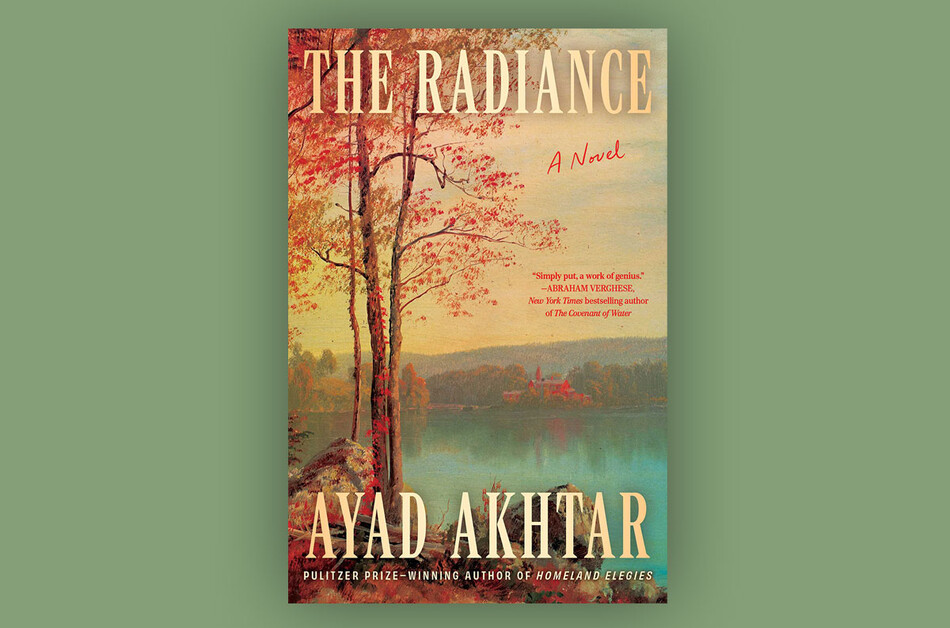
The narrator and protagonist of The Radiance is a man with a lot on his mind: science, psychology, sociology, philosophy Eastern and Western, culture high and low — not to mention the wackier-than-your-wildest-dreams state of modern-day academia. And that mind, in the aftermath of a devastating injury, is behaving erratically. This condition of “altered perception,” which doctors cannot explain, permeates everything that happens in The Radiance and is a source of both alarm and a euphoric sense of wonder (hence the book’s title). Characteristically, author Ayad Akhtar ’02SOA probes these mysterious, even mystical, neurological effects — which, along with weird bouts of bodily dissociation, produce vividly prescient dreams and visions that, in the hands of a lesser writer, might come off as intolerably trippy or woo-woo — with a clear-eyed intellectual rigor and passion for learning that will be familiar to readers of his 2020 tour de force, Homeland Elegies.
And like that earlier novel, The Radiance revolves around narrator Ayad, a successful writer (a clear alter ego for Akhtar, a much-awarded playwright and novelist) who is a “non-Muslim Muslim-American who could not seem to escape the Islam that played no meaningful role in his life.” Ayad has moved, early in the COVID-19 pandemic, from New York City to a deeply polarized, almost entirely white community in New York State’s Hudson Valley. From his rental house on the edge of town, Ayad soon gets entwined in a plot woven from four separate, only mildly overlapping, threads: his work with a local police detective to track down the hit-and-run driver who left Ayad for dead on a deserted road; his cousin’s revelation of shocking family secrets; his treatment by a brilliant psychiatrist to get to the bottom of his bizarre symptoms; and his involvement with a local literature professor, whose relationship with an unstable student precipitates a huge scandal.
Akhtar keeps all these balls in the air throughout the novel, but the heart of the story is Ayad’s infatuation (rapturous but nonsexual, given the loss of libido that accompanies his injuries) with Lucie Neraponte, the aforementioned professor at the area’s highly progressive liberal arts college. Lucie’s chief claim to literary fame rests on a widely anthologized essay that details her passionate affair, back in 1990, when she was a junior at the University of Chicago, with her married fifty-two-year-old professor — a coupling that is anathema to the current college generation, which, as Lucie puts it, “flatten[s] the world into abusers and their victims.” Ayad is fascinated by Lucie’s backstory, and awed by her unorthodox intellect and fluency on topics as disparate as Tibetan monks and Dostoyevsky’s descriptions in The Idiot of epilepsy (an ailment that Lucie believes offers a parallel to the neurological transformations Ayad is experiencing).
The almost scholarly nature of their relationship, which ends after scandal erupts, reflects another characteristic of Akhtar’s work, whether drama or prose: his propensity for taking on big, important, even third-rail topics. This is a writer in love with ideas (not polemics), and The Radiance is full to bursting with them. Another charming hallmark of Akhtar’s digressive, overtly intellectual style is his fondness for half burying within a footnote a provocative concept the main text can’t quite accommodate — for example, one character’s almost offhand conflation of knowledge and sex as equal sources of pleasure.
If all of the above makes The Radiance sound impossibly high-minded or even ponderous, do not fear. Yes, this book serves readers a dissertation’s worth of food for thought, but ultimately its power derives from that seemingly tossed-off notion of knowledge as pleasure: Akhtar has written a stunning novel of ideas that is simultaneously a pure delight to read.