It’s Sunday morning at St. Bartholomew’s Church on Park Avenue, and the Reverend Deacon John Wirenius ’90LAW is in high spirits. For today is the feast day — that is, the death day, the enter-heaven day — of St. Francis of Assisi, patron saint of animals, who died exactly eight hundred years ago. Wirenius, whose Brooklyn household includes three cats, cuts a benevolent figure in his green and gold tunic and round wireframe glasses. To the pipe-organ swells of “The Cuckoo and the Nightingale” from Handel’s Organ Concerto in F Major, he leads a procession of white-robed acolytes, choir members, and clergy down the long aisle of the barrel-vaulted church, with its golden domes and Byzantine-style glass mosaics.
This is the day when congregants bring their nonhuman companions to be blessed. The predominant genus, of course, is canis familiaris. Poodles, terriers, and setters sit obediently in the pews, some attired in seasonal sweaters. One Yorkie wears a pink ruffled dress. The preacher’s sermon, which concerns humankind’s responsibility to safeguard Creation, is punctuated by yips and yaps and the occasional meaty bark.
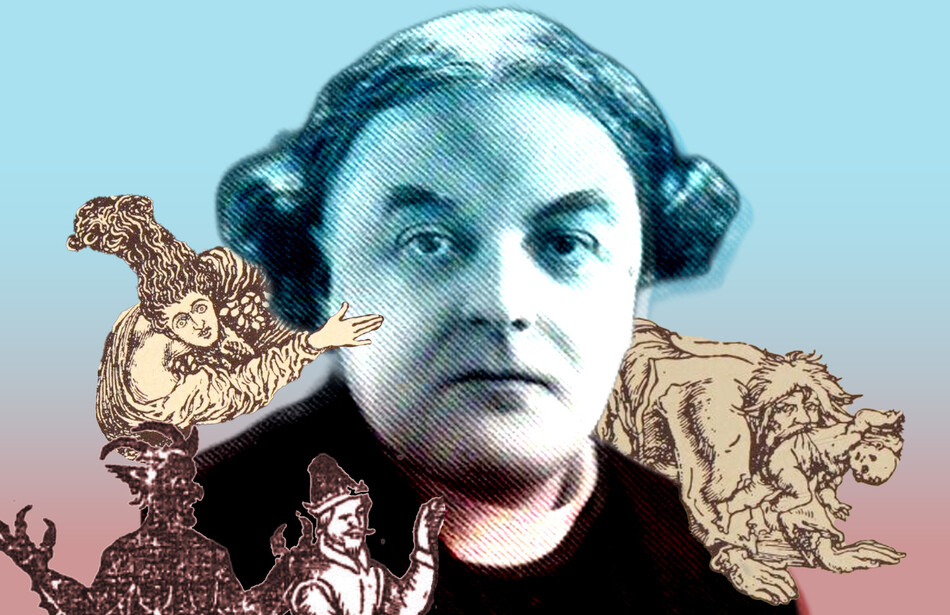
Wirenius, a labor lawyer who was ordained into the ministry in 2015, has been thinking a lot about beasts lately. Wolves, mostly. His new book, Montague Summers, Occultist: A Study on the Writings of Witches, Vampires, and Werewolves, is the first biography of Summers, who, in the first half of the twentieth century, fashioned himself the world’s leading authority of the supernatural.
When the church service ends — after the animals (dogs, cats, and at least one rabbit) have been sprinkled with holy water — Wirenius goes outside onto the white steps to shake the hands (and paws) of the departing worshipers. Then he goes back into the church, removes his vestments, slips into a side room containing a baptismal font and two small wooden chairs, and talks about Montague Summers.
Summers was born in Bristol, England, in 1880, and in 1908 was ordained as a deacon in the Church of England. He wanted to rise higher on the clerical ladder, but was thwarted by scandal: Swirling around him were rumors and accusations of homosexuality, pederasty, and Satanism. “Young Montague Summers was religious,” says Wirenius, “and when he became an adult, his sexual proclivities made it very difficult for him to not get into trouble. His father knew he was gay and did not approve. But unlike a lot of fathers in that Victorian age, he did not cut Montague off financially.”
Though the Church acquitted Summers of the charges, his career was ruined, and in 1909 he converted to Catholicism. Henceforth he claimed, without proof, to be a Catholic priest. To further his claim, Summers, a man of the theater, began dressing like a Louis XIV-era French abbé: black cassock, shovel hat, colored silk socks, buckled shoes. A self-made anachronism, he styled his hair to resemble an eighteenth-century powdered wig, and changed his name to the Reverend Alphonsus Joseph-Mary Augustus Montague Summers, after Saint Alphonsus Liguori, the patron saint of confessors. Summers’s flamboyance and erudition were matched only by his fevered interest in the occult, whose manifestations he taxonomized in florid prose.
In The History of Witchcraft and Demonology (1926), Summers endeavored to “show the witch as she really was — an evil liver; a social pest and parasite; the devotee of a loathly and obscene creed; an adept at poisoning, blackmail, and other creeping crimes; a member of a power secret organization inimical to Church and State; a blasphemer in word and deed.” In The Werewolf (1933), Summers defined the eponymous creature as a human being who “changes or is metamorphosed into the apparent shape of a wolf, and who is then possessed of all the characteristics, the foul appetites, ferocity, cunning, the brute strength, and swiftness of that animal,” yet who, at the sight of the Crucifix or Madonna, falls “impotent to the ground,” proving that “he is in truth possessed of the demon.”
Wirenius first encountered Summers as a child in Floral Park, New York, a suburb of Queens, where he was allowed to “run amok,” as he says, in the local library. By seven he was a serious reader. One day, his school had a book fair, and Wirenius bought Bram Stoker’s Dracula. There were two other vampire books as well: Vampires: Stories of the Supernatural, by Aleksey Konstantinovich Tolstoy, and a thicker volume with a striking brick-red cover, titled The Vampire and His Kith and Kin (1928), by Montague Summers. The Summers book, with its odd detours into Latin, was a global survey of vampirism in all its facets. “Throughout the whole vast shadowy world of ghosts and demons,” it began, “there is no figure so terrible, no figure so dreaded and abhorred, yet dight with such fearful fascination, as the vampire.”
Wirenius never forgot that red cover. And as his horror fandom grew, he would, every so often, bump into the name Montague Summers. Soon he started hunting down Summers’s works.
“His two books on vampires are superb,” says Wirenius. “He also translated The Malleus Maleficarum — The Witch’s Hammer — which is the famous fifteenth-century witch-hunting manual. Summers believed in witchcraft. Something has to prevent evil from destroying good, and for Summers that meant destroying witches. Later he wrote another book about the evil of witches, and how witches lead to vampirism. The idea is, if you die in a place of sin, like a witch, you’re probably going to either become a werewolf or a vampire. Summers believed all of it.”
Academics of the day were skeptical of this freelance scholar. In 1930, the Romanic Review, a quarterly published by Columbia’s Department of Romantic Languages, printed a critique of The Vampire: His Kith and Kin. The writer, Gustave Leopold Van Roosbroeck, a professor of French, seized on Summers’s observation that there was something suspicious about the lack of verified accounts of vampirism in Western Europe. “To explain the astounding paucity of records about vampires in nations where education has had its influence,” Roosbroeck wrote, “[Summers] suggests that some sinister group, possibly the Freemasons, or the Jesuits, or the Bolsheviki, or the Intellectuals, I surmise — are conspiring with Organized Vampirism itself to suppress the news of its unceasing activities.” And in a 1926 review, a draft of which resides in Columbia’s Rare Book and Manuscript Library, the Harlem-based writer Hubert H. Harrison tackled The History of Witchcraft and Demonology, writing that “the author of this work is a studious and learned man, but his book demonstrates that learning does not always produce intelligence. His study of the records of witch trials takes him into many dark corners of the human mind, from which he emerges as narrow, dogmatic, and bigoted as he was before.”
Wirenius attributes some of Summers’s fanatical antipathy toward witches to his resentment of Margaret A. Murray, an archaeologist and anthropologist whose book The Witch-Cult in Western Europe (1921) argued that European witch trials were an attempt to eradicate a surviving, organized, pre-Christian fertility religion. “She got published by Oxford University Press, and he got published by a less publisher, so he did not like her,” says Wirenius. “In fact, he hated her. For one thing, she was a woman. For another, she was on the side of the witches.”
In later years, Summers lived with his partner and personal secretary, Hector Stewart Forbes, and his beloved dog, Tango. “Hector was a piano player and liked the good life,” says Wirenius. “They basically took up house together and had a surprisingly good union.”
The relationship lasted until Summers’s death on August 10, 1948. Summers wanted a Catholic grave, but the parish rector did not recognize him as a Catholic priest and “would not let him be buried in hallowed ground,” Wirenius says. Instead, Summers was interred in London’s Richmond Cemetery, dressed, according to his wishes, in his clerical garb and accompanied in his coffin by the preserved coat of his dear departed Tango.
“Do I believe in the occult?” says Wirenius, posing the delicate question himself. “No, I do not. What interests me is our enduring fascination for the occult.” For Wirenius, an eager connoisseur of macabre books and films, the pop-horror genre, like other forms of escapist fantasy, is purgative. “It can,” he says, “be a way of clearing one’s soul.”
The church has emptied out, and the animals are long gone. It’s time for Wirenius to go home to Brooklyn, to his wife and his books, to his violin, and to his brood of furry quadrupeds.
Some may wonder why he has dedicated so much of himself to so peculiar a character as Summers. But Wirenius knows the answer. “I couldn’t not write the book,” he says. “I have an affection for Montague which he may not deserve, but it’s enough affection for me to write about him. Summers grows on you, and he can really get you interested.”
Nearly eighty years after his death, Summers remains obscure, but, like a vampire, he can’t seem to die.
“Every now and again,” says Wirenius, “you’ll see him pop up.”