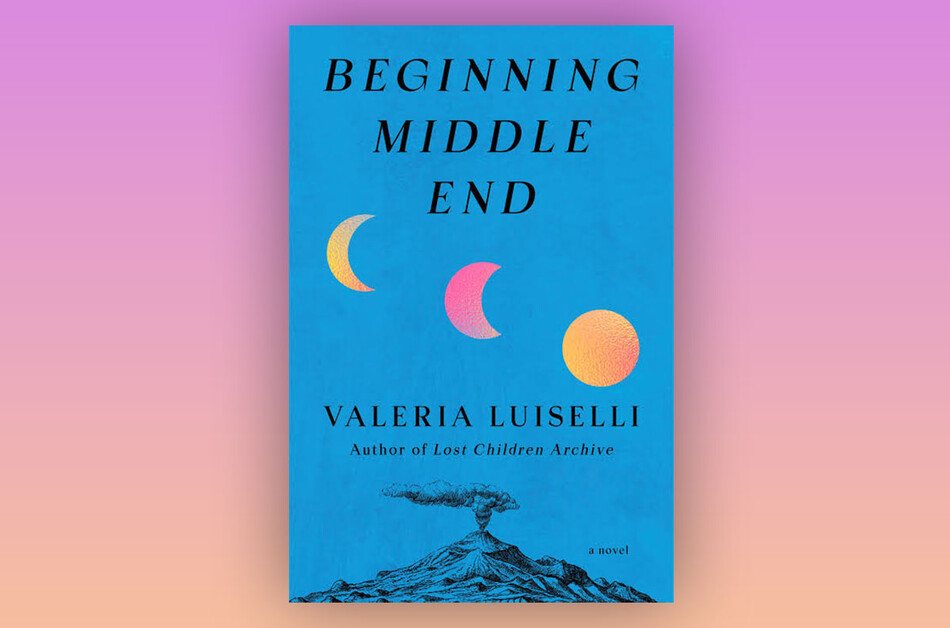
“All I had to do, or so I thought, was to answer a simple question: How do I reinvent it, the story, our lives?” Valeria Luiselli ’15GSAS writes at the outset of her remarkable fourth novel, Beginning Middle End. But in life and in writing, beginning again is never simple, especially when one feels “on the edge of something ineffable.”
The novel’s unnamed narrator, an author who shares biographical details with Luiselli — both were born in Mexico, live in New York City, and write about the US–Mexico borderlands — has recently divorced the stepfather of her precocious twelve-year-old daughter, separating the only family unit the child has ever known. Her daughter, also unnamed, is beginning to keep secrets and plot her own path, complicating the narrator’s search for a new start for them. Another preoccupation: The narrator’s strident, independent mother appears to be developing dementia, circling an ending rather than a new beginning. “Mother on my shoulders, daughter by my side — how do I get us where we all need to be?” the narrator wonders.
Atop this poignant intergenerational challenge, Luiselli layers ancient and natural history that highlights the mutability of the world and the smallness of human life within it. At the outset of Beginning Middle End, the narrator and her daughter settle for the summer in Catania, Sicily, which seems an auspicious place to start over, not just for its mythological and philosophical significance but also for reasons of personal inheritance. The narrator’s maternal grandmother was born in Philosophiana, a tiny town in the center of the island that once served as a way station for travelers between coasts. In Catania, mother and daughter scrutinize texts that will be all too familiar to alumni of the Core Curriculum, including The Aeneid and The Odyssey, finding symbolic resonance in references to Sicily and the nearby islands where the Greeks believed the god Aeolus housed all the world’s winds. Indeed, Luiselli structures the novel’s major sections around four of those winds: the Levante, the Ponente, the Scirocco, and the Mistral, which whip smoke and ash from wildfires and the exploding Mount Etna across the island, complicating the characters’ summer plans.
What links all the layers — and ingeniously drives the plot of Beginning Middle End — is an object passed down through four generations of women in the narrator’s family: an ancient Roman mosaic fragment depicting Proteus, the “elusive, ever-shifting” sea god who can see past, present, and future “in complete clarity” and whose name, Ovid writes in Metamorphoses, means “origin.” The narrator’s grandmother discovered the Proteus mosaic in the 1920s, when she was twenty-one, while laboring on an archaeological dig north of Philosophiana that uncovered the Villa Romana del Casale, a palace constructed in the fourth century AD. She took the mosaic with her when she boarded a ship in the port of Catania, in search of a route out of the poverty that defined her life. She settled in Mexico and never returned to the place of her birth, passing down the mosaic when she descended into dementia.
Now the narrator’s mother, in a similar position, has passed the mosaic on. The daughter, though, becomes fixated on returning the Proteus to Villa Casale, a fantasy of restoration that she hopes will realign their family and that sets the pair on a road trip. Through the quest, Luiselli — a 2019 MacArthur “genius grant” winner, whose previous books Lost Children Archive and Tell Me How It Ends focused on migration and identity — takes opportunities to meditate on the difficult questions of ownership, provenance, and belonging in a world marked by plunder and perpetual displacement.
As the narrator struggles against these questions and the sense that “maybe all that there is, is the middle, bending, sinuous, constantly flowing back into itself,” her daughter takes over, writing to her grandmother and imagining an ending to the story — which is also a beginning full of possibility for their family. It makes for a poetic exploration of mothers and daughters, one that is set against “the much greater epic of the natural world.”