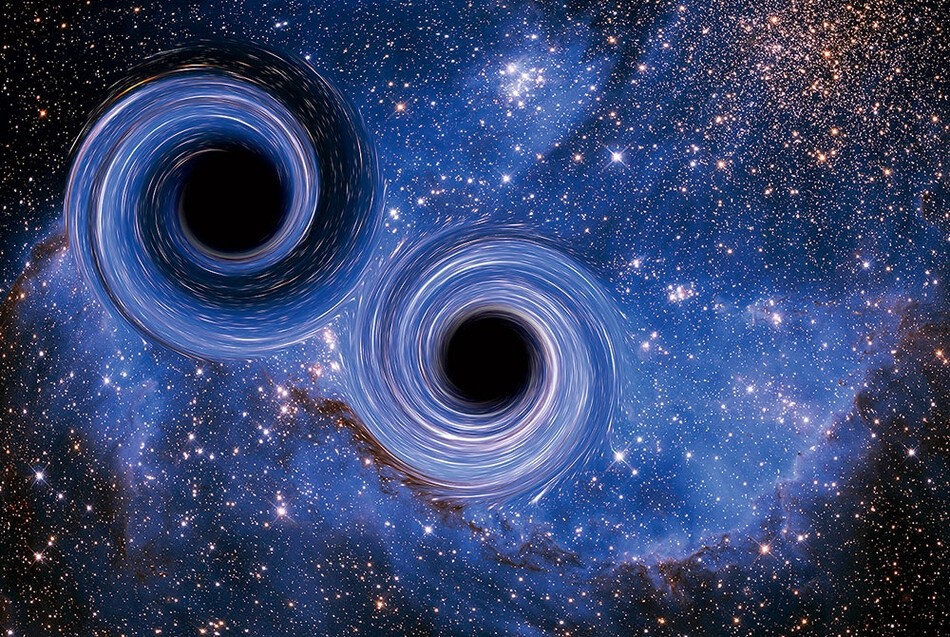
By listening to gravitational waves, or tiny ripples in the fabric of space-time, an international team of astronomers that includes Columbia professor Maximiliano Isi has roughly doubled the total number of black-hole collisions ever identified, to nearly four hundred.
The new observations, using data from detectors in the states of Washington and Louisiana, as well as in Italy and Japan, have enabled the researchers to refine measurements of the universe’s expansion rate, discover two unique types of black holes, and determine multiple pathways by which black holes are created.
Isi contributed a key analysis showing that black holes are split into two distinct groups: a majority that spin very slowly, and a minority that spin extremely fast. That finding has far-reaching implications for our theories about where these black holes come from and how they are formed.
The question of whether massive black holes come directly from dying stars or are assembled step-by-step from the mergers of smaller black holes is still hotly debated. The diversity in spins identified by Isi suggests that both mechanisms may be at play.
“With this catalog, we now have enough data that we can start to tease apart the properties of these black holes and to figure out where they came from,” says Isi. “We’re also able to chart the expansion of the universe over its history, which is a super-important, unanswered question in cosmology.”
This article appears in the Fall 2026 print edition of Columbia Magazine with the title "Black hole roll call."